Through the ISO video by MinutePhysics, I came across the website Photons to Photos.
This site contains a lot of information about camera sensors.
What I found particularly interesting is a comparison chart that shows, for different camera models, at which ISO levels it makes no difference whether you brighten dark areas later in RAW processing, and when it is better to set the correct ISO already at the time of capture—because otherwise dark areas can only be recovered at the cost of significant noise.
The following chart shows the values for my cameras.
The x-axis represents the ISO value, and the y-axis shows the difference (!) in exposure value (EV) relative to the base ISO (typically ISO 100).
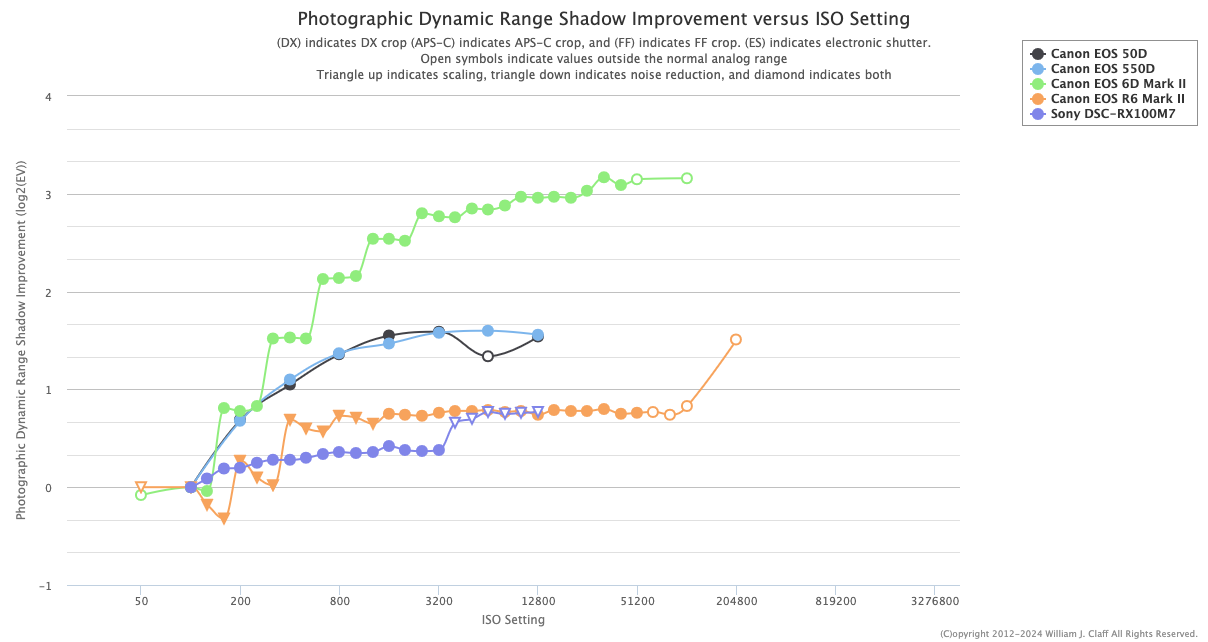
It can be read as follows:
- Compared to using a higher ISO at capture:
- how much worse would it be to increase brightness later in the RAW converter?
Concretely for this chart:
- If you take a photo at ISO 800, the dark areas will exhibit less noise and retain more detail than if you had taken the same photo at ISO 100 and later brightened it in RAW processing to the equivalent brightness of ISO 800.
- With the Canon EOS 6D Mark II (green curve), such a later adjustment would correspond to a difference of about 2.2 EV in dark areas.
- With the Canon EOS R6 Mark II (orange curve), the difference would be about 0.8 EV in dark areas.
Exposure value (EV) is logarithmic! This means that 2.2 EV is roughly 2.6 times worse than 0.8 EV.
This matches my experience: with my relatively new Canon EOS R6 Mark II, I can adjust exposure much more in post-processing without that noise is becoming a major problem. With my older 6D Mark II, I must choose a good ISO value at the time of capturing, otherwise noise would quickly become noticeable during post-processing.
So what can we learn from this?
- Modern cameras are much more forgiving when it comes to suboptimal ISO settings than older cameras.
The key concept here is ISO invariance: it makes little difference whether brightness is set via ISO at capture or adjusted later in post-processing. - You can clearly see how important it is, depending on the camera, to choose the correct ISO already at the time of capture.
- This site is a useful additional resource for comparing cameras (for example, before making a purchase).